Pages

Showing posts with label Ceramics. Show all posts

Friday, 3 October 2014

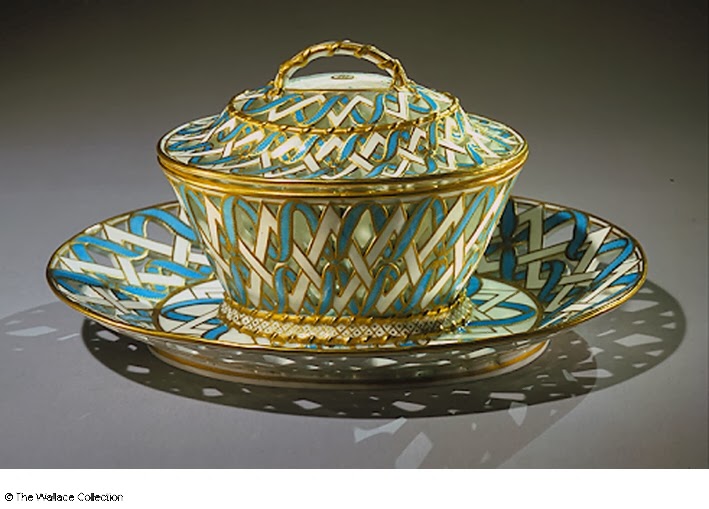
A Dish of Marrons


© By kind permission of the Trustees of the Wallace Collection

It's chestnut season, which gives me the chance to share this delicious marronnière as my Take One Dish offering this month.  This beautiful soft-base porcelain chestnut basket with white, and turquoise-blue enamelling and gilding was made in the Sèvres factory in 1759-60.  It bears a painter's mark of a candlestick with smoking candle, presumed to be that of an unidentified ground-colour painter.  By the time this was made, Sèvres was under the patronage of Louis XV and his mistress Madame de Pompadour and the factory had moved from Vincennes to Sèvres.  This particular piece is in the care of The Wallace Collection in London which has the finest museum collection of Sèvres porcelain in the world.

Sugared chestnuts, or Marrons Glacés, were a particular delicacy in the 1700s and marronnières were produced for serving them elegantly.  Plainer chestnut bowls were produced by Sèvres but intricate baskets, such as this, cost nearly twice as much.  It would have had to be fired three times, once for the body and ground colour, again for the enamel colours and finally for the gilding.  Great skill would have been required to prevent sagging and separation of the latticework.  Marrons Glacés are at their best after being freshly submerged in warm syrup.  The basket's piercings allow for moisture and excess syrup to escape so that the marrons are served at their best.

Marrons Glacés

There are recipes out there for Marrons Glacés.  It's tempting to have a go, given how expensive they are to buy, but I've seen it done by professionals and believe me it's an art.  Chestnuts are unlike other common nuts in that they store their energy for future seedlings in the form of starch rather than oil so they need to be cooked.  They have a satisfyingly mealy texture and are not only suitable for sweet but also for savoury use. Newly gathered, keeping them at room temperature for a few days allows some starch to be converted to sugar which improves the flavour.  If you want to keep them for longer you need to skin and preserve them by drying, freezing or vacuum-packing.  Once skinned, they can be added to stuffings, soups and casseroles.  A salad of radicchio, bacon and fried chestnuts with a warm mustardy dressing makes a wonderful autumn dish.  Lightly salted chestnuts are delicious served with an aperitif.  Pureed chestnuts are the basis for a number of rich desserts.  Dried and ground to a fine powder, they produce a flour that is particularly appreciated in northern Italy and Tuscany for making fritters, breads, cakes and even pasta - although it does have to be mixed with a flour containing gluten to produce Italy's favourite staple food.

Peeling chestnuts hot from the fire is hard to beat.  Slashed with a sharp knife then piled into an old chestnut roaster or iron pot, if you're lucky enough to have either, and pushed deep into hot coals, they emerge smoky, sweet and yielding.  Deeply knicked, spread on a baking tray and sprinkled with water they can be baked in a medium oven for 15-20 minutes or the pierced nuts can be tossed in a dry frying pan for 10 minutes. Alternatively, after cutting into the thick skin you can drop them in a pan of boiling water for 5 minutes before peeling.  Ah, the peeling!  The nuts need to be skinned hot if you're to properly remove the thin fuzzy skin beneath the hard outer.  A tea towel will protect your hands and you can return nuts to the heat if they cool too much for skinning.  Ready-skinned and vacuum-packed French chestnuts are a fallback option, and a good one if you need a lot, although not quite as tasty and evocative of cool, misty autumn days.

Freshly gathered chestnuts

This is the weather the cuckoo likes,
And so do I;
When showers betumble the chestnut spikes,
And nestlings fly:
Thomas Hardy

From subsistence food to luxury treat, the chestnut retains its appeal.  As for those Marrons Glacés, they are so rich even I can only manage one at a sitting so I'm happy to leave their making to an expert.  I keep coming back to the memory of still-warm glacé chestnuts at a demonstration in London by Romanengo fu Stefano, the outstanding confectioner of Genoa, Italy who've been making them since 1780.

There are plenty of easier uses for chestnuts.  Here is a savoury recipe adapted from Claudia Roden's The Food Spain.  It's peasant food which originally would have been made with dried chestnuts and beans re-hydrated when a hearty, warming dish was needed.  Adding some sliced cooking chorizo at the same time as the beans turns this from a thick soup to a more substantial main dish.

Haricot Beans with Chestnuts
(judias blancas con castañas)

2 tablespoons olive oil
  • 1 medium onion, peeled and roughly chopped
  • 3 garlic cloves, peeled and chopped
  • 250g peeled chestnuts
  • 1 cinnamon stick
  • 2 cloves
  • Salt & pepper
  • 700g pre-cooked haricot or butter beans (drained weight)
  • A little extra virgin olive oil

Fry the onion in the oil over a low heat, stirring often, until soft.  Add the garlic and cook for a further 2 minutes.  Add the chestnuts and barely cover with water.  Add the cinnamon stick and cloves and season with salt and pepper.  Bring the pot to a simmer and cook for 15 minutes.  Stir in the beans and cook for a further 10 minutes.  Serve warm with a dash of extra virgin olive oil.


Sources:

Wednesday, 3 September 2014

Azulejos to Bacalhau

Azulejos (1) at the Museu Nacional do Azulejo, Lisbon
Photograph: 
©Take One Dish

The 'Dish' in the frame this month is of the edible variety but, bear with me, because there is a connection with the delicious tile panel above.

It's impossible to take a walk around Lisbon without being struck by the Portuguese love affair with tiles, or azulejos.  Everything from a grand palácio to a humble casa might have its architectural credentials embellished with a touch of earthenware art.  Inside, you could find floors and walls from corredor to quarto decorated with these practical and beautiful tiles.  In Portugal, particularly, tiles bridge the divide between the majestic and the domestic. Unsurprisingly it was the tiles of the cozinha that particularly caught my eye.

Azulejos were introduced into Portugal by the invading Moors in the the early 15thC.  By the 16thC  European patterns and techniques began to influence tastes.  The second half of the 17thC saw a fashion for the distinctive cobalt-blue and white, tin-glazed, earthenware tiles from the Netherlands.  Only when imports were stopped by King Pedro II did the Portuguese industry truly take off.  Workshops such as that of Gabriel del Barco, a Spaniard working in Portugal, led the way for the country to find its own style in tile design.

Portugal's expansionist policies saw designs taking inspiration from the Far East and India.  By the early 18thC tile painters such as António Pereira and Manuel dos Santos were appreciated as artists and began to sign their tile panels. Historical panels became popular. The most famous example is in the Museu Nacional do Azulejos in Lisbon and depicts the city as it was before the great earthquake of 1755.  Also at this time, the "Figuras de Convite" (Welcoming Figures) of noblemen and elegant ladies, specific to Portugal, were created to line palace entrances.  Wider demand for azulejos for architectural and domestic interiors in Portugal and her colonies led to the mass production of simple, repetitive designs.

The social changes which took place in the mid-19thC changed the market for tiling to a more utilitarian one and new techniques of transfer-printing were adopted.  The 20thC Art Nouveau and Art Deco styles saw expression in Portuguese tile designs, exemplified by artist Rafael Bordalo Pinheiro.  The work of Maria Keil brought abstract design to street and underground station tiling in the 1950s.  This use in public spaces continues to the present day and now embraces artists from around the world, sometimes employing computer technology to achieve their designs.

Azulejos (2) at the Museu Nacional do Azulejo, Lisbon
Photograph: 
©Take One Dish

These photographs of cozinha tiles were taken at Lisbon's Museu Nacional do Azulejos.  Here, in a 16th century former convent is the largest collection of Portuguese tiles in the world.  Exhibits date from 1580 onwards.  I wonder whether the fish depicted can, more easily, be identified by a local than by me.  The tangles of eels is a simple one; a pair of plaice, perhaps; maybe a quintuplet of mullet; surely a cod.  The cod is certainly a fish appreciated by the Portuguese, though historically more in its salted form of bacalhau than fresh.  Portugal sought the cod as far as the coast of North East America.  Mark Kurlansky in his book Cod - A biography of the Fish That Changed the Word points out that a 1502 map identifies Newfoundland as "land of the King of Portugal".  Dangerous though the journey was, "by 1508, 10% of the fish sold in the Portuguese ports of Douro and Minho was Newfoundland salt cod".

For each mouth, a different soup
Portuguese proverb

Salt cod needs to be properly re-hydrated to achieve the right consistency and pungency.  When done well it is a glorious thing.  Brandade is my preferred way of using it and this recipe is adapted from that in one of my favourite books, Simon Hopkinson's Roast Chicken and Other Stories.  You will need to soak the salt cod in cold water for 24-48 hours (depending on the grade of your salt cod) beforehand, changing the water several times.  I prefer to buy "green" salt cod if I can get it - it's less salted so has a shorter shelf-life and 24 hours soaking is quite enough.

Brandade
(Serves 4)

1 large potato (about 175g/6 oz), peeled and diced
200ml (7 fl oz) best quality olive oil
200ml (7 fl oz) milk
3 garlic cloves, peeled and crushed
450g (16 oz) salt cod fillet, soaked, drained and boned 
Juice of 1 lemon
Pepper

Boil the diced potato in salted water until cooked.  Drain and ensure it is completely dry before mashing while still hot.  Keep warm.
Gently heat the olive oil, milk and garlic together in a small pan until warm.
Put the cod in a pan of cold water and bring to the boil.  Switch off the heat and leave for 5 minutes.
Lift the cod out and discard the skin.  Place the cod in a food processor and, with the motor running, gradually add the olive oil, milk and garlicky mixture.  Process briefly to a thick, sloppy consistency.  
Add the mashed potato and blend very briefly (too much and it will become gluey).  Season with the lemon juice and pepper.  Taste and add salt only if needed.

I share Simon Hopkinson's taste for serving a dish of brandade with a slick of olive oil, some fried bread, and, maybe, a few healthy black olives.

Sources:
Museu Nacional do Azulejo, Lisbon
Portuguese art: Portuguese Azulejos by Rosie Mitchell
Cod - A biography of the Fish That Changed the Word by Mark Kurlansky
Roast Chicken and Other Stories by Simon Hopkinson

Sunday, 3 August 2014

Take a Dish of Tea

Stoneware glazed bowl; made 1100-1299; Jiangxi, China
© Victoria and Albert Museum, London


An early reference to a 'dish of tea' appears in William Congreve's 1694 comic play 'Double Dealer' when Lady Touchwood invites Sir Paul Plyant to "drink a dish of tea to settle our heads".  The scandalous aristocrat Lady Mary Wortley Montagu wrote in a letter in 1718 of visiting Greece and imagining how agreeable it would have been "when, after drinking a dish of tea with Sapho, I might have gone the same evening to visit the temple of Homer in Chios ...".  Then, in William Makepeace Thackeray's satire on early 19th century Britain, 'Vanity Fair', the Clapp family was still able, despite straightened circumstances, to "give a friend a dish of tea".

Dish (noun): "A shallow,  flat-bottomed container for cooking or serving food"
Oxford English Dictionary

Most ceramic collections refer to these as 'bowls'  or 'tea bowls' .  So, why the literary references to 'a dish' rather than a bowl?  Could it be that using the word 'dish' instead of 'bowl' was highlighting a British affectation?  But, enough of this.  The star of this piece is a wonderful Chinese tea bowl and the term hare's fur is so beautifully descriptive of the glaze.

Bowl (noun): "A round, deep dish or basin used for food or liquid"
Oxford English Dictionary

Our taste for tea came from China where the Camellia sinensis was first grown and the expertise to turn it into a delicious drink/food was born.  Tea was served in a handleless vessel, a custom which crossed borders along with the appreciation of tea drinking, and later the plant itself.  The handled cup we know today was being made in Britain by 1740, almost a decade after tea first arrived here.  Cups were more expensive to make and more difficult to transport to markets as they didn't stack so neatly, but it seems 'delicate' ladies fingers had to be protected from the heat of the bowl.

The Chinese had, by this time, been making tea for millennia.  By the 10th century, tea drinking tastes there changed from leaf tea to powdered green tea which continued for four centuries before there was a return to steeped leaf tea.  Drinking a steeped leaf tea from a green bowl was considered elegant and tasteful but a frothy whipped powdered green tea looked much more appealing when served in a brown or black bowl.  So began the manufacture of dark glazed bowls in the southern provinces of Fujian and Jiangxi in10th century China.  Manipulation of the glazing, firing and cooling processes resulted in effects including tortoiseshell, oil spot and hare's fur glazes.  The 'hare's fur' tea bowl, above, is in the possession of the V&A Museum in London.  Three flying Phoenixes further decorate the bowl.  These were created using the 'resist' method which was a speciality of Jizhou potters.  Paper silhouettes were applied between a dark brown first glaze and a second lighter toned one, the paper burned away in the kiln leaving outline impressions on the bowl.

With the exception of Lady Mary Wortley Montagu, who seemed to be serious in her pretensions - Her 'Turkish Embassy Letters' were published only after her death as she believed "a person of quality should never turn author"- the examples of the use of 'dish' I've mentioned are taken from satirical writing.  So, 'bowl' it is.  Despite the invention of the handled 'cup', some of us retain a fondness for ignoring the handle and enclosing the vessel in our hands.  Just to complicate things further we term it "cupping".  You've got to envy the man or woman who got to 'cup' this hare's fur bowl in their hands.


Tea-poached prunes & Buttermilk pudding


Here is a simple recipe for tea-poached prunes.  They're good served with double cream but they go well with a buttermilk pudding so I've given you a recipe for that too.  

Tea-poached Prunes (Adapted from Chez Panisse Fruit by Alice Waters)

250ml (10 fl oz) water
1 tablespoon loose black tea (Earl Grey works well)
140g (5 oz) pitted prunes
45g (1½ oz) caster sugar

Bring the water to boil in a small non-reactive pan.  
Remove from the heat and add the tea.  
Leave to steep for 3 minutes.
Strain out the tea leaves and pour the liquid back into the pan.  Add the prunes and the sugar. Stir to dissolve the sugar and heat gently for 10 minutes to soften the prunes.  
Remove from the heat.
When cold, pour the pan contents into a porcelain or glass bowl, cover tightly and refrigerate until needed (keeps up to 1 week).

Buttermilk Pudding
(Serves 6)
3 leaves of gelatin
150ml (5fl oz) double cream
70g 2½ oz caster sugar
1 vanilla pod, split
450ml (16fl oz) buttermilk*


Cover the gelatine leaves in cold water and leave to soften for 3-4 minutes.
Place the cream and sugar in a pan along with the scraped out seeds and pod of the vanilla. 
Bring to the boil, stirring constantly to dissolve the sugar then remove from the heat.
Remove the gelatine leaves from the water, squeezing out any excess, and stir the gelatine into the warm cream.
Remove the vanilla pod and stir in the buttermilk.
Pour the mix into small ramekins and place in the fridge for at least three hours or overnight.
When ready to serve, put a few centimetres of hot water in a shallow bowl and quickly dip the ramekins in for a 3-4 seconds to loosen the buttermilk puddings from the sides.  Dry the ramekins, place a plate on top of each and invert to turn out (you'll hear a distinctive 'slurp' sound - if not, dip the ramekin in hot water again for another second and repeat the process.
Serve with a few poached prunes and a little of the liquor.
Sources:
V&A Museum
“Drinking a dish of tea with Sapho": The sexual fantasies of Lady Mary Wortley Mongagu and Lord Byron by Alison Winch
Chez Panisse Fruit by Alice Waters

* Buttermilk is a by-product of butter-making.  It is the low-fat, milky liquid that separates off during the process.  I use "pasteurised buttermilk" rather than "cultured buttermilk" which is thicker and has a longer shelf-life but I haven't tested it in this recipe.


Thursday, 3 July 2014

Tea with Susie Cooper

Susie Cooper Bone China
Design: Glen Mist 1956-1960
Photograph: Take One Dish

My flat is tiny, yet I have a whole kitchen cupboard given over to something I don't even feel is mine.  It's one of those treasured possessions that get passed down through families.  You hope when it happens to you it will be a small tactile bronze you can place on a bookshelf or a little watercolour that looks just right hanging above that chair in the corner.  I have a 22-piece delicate bone china tea service.  It's beautiful but makes an appearance rarely for fear a careless sweep of the hand should wound its perfection.  It belonged to my 'mother-in-law' and I'm sure she'd be dismayed that I feel this way about it.  

The Set was designed by Susie Cooper and the mark shows it was produced by her own factory in the late 1950's.  The design is 'Glen Mist' and it continued to be produced by Wedgwood for many years after their takeover of Susie Cooper's business.  The V&A Museum, who have a later, Wedgwood produced, example in their collection, describe the design as: White body with clear glaze. Rim of plate edged with pale grey-blue band. At the centre, covercoat with pattern of two flowers and a bud (poppies) in powder-blue, pale green and pale khaki, on stems.

Susie Cooper was a woman in a hurry.  Intending to study Fashion after taking art classes at the Burslem School of Art, she was rejected by London's Royal College of Art for not having relevant work experience.  To gain that, she joined potters AE Gray in her home town of Stoke on Trent as a paintress.  She was quickly appointed resident designer and given her own designer mark.  It was 1922, she was 20 years old.  Seven years later she opened her own 'Susie Cooper pottery' business.  Within 2 years she had moved the pottery twice, arriving at her celebrated 'Crown Works' in Burslem in 1931.  By the late 1930's Cooper was supplying her good value, functional, modern,  and innovative earthenware designs to stores like Harrods, Selfridges, Peter Jones and Heals.

In the early years she bought in 'white ware', decorating the earthenware pieces in the bold colour floral, geometric and modernist designs popular at the time.  Soon the development of lithographic patterns and crayon decoration brought a move away from hand-painting.  Fire damage at the works, which also destroyed her stock of lithographs, closed the factory between 1942-1945.  After the war, rationing restrictions forced a return to techniques of hand-painting, aerograph and sgraffito decoration.  Cooper's colours became more subdued and organic and plant forms informed the designs.

In 1950 Susie Cooper acquired the manufacturer Jason China Compnay Ltd and began designing new shapes for the process. 1957 saw a second fire at the Crown Works, ceasing production for a year.  In 1958, with ambitions to produce a range of dinnerware, she merged the company with RH & SL Plant, but the Crown Works remained her hub. A successful takeover bid in the 1960s resulted in the business becoming part of the Wedgwood Group.  Cooper continued to work on designs and had her own 'Wedgwood' mark.  Frustrations with corporate structure coincided with the death of her husband and in 1972 she resigned as a Director but continued to design for Wedgwood, and others, into the early 1980s.  In 1979 recession hit and Wedgwood closed Cooper's beloved Crown Works.  Creative and determined, Susie Cooper was an icon of design.  She died in 1995.


Yorkshire Curd Tart
served on Susie Cooper
'Glen Mist' design bone china tea service

Photograph: Take One Dish

My 'mother-in-law' was a Yorkshire woman and had to pass on her treasured possessions far too soon.  She was the kindest person I ever knew so, when I make a Yorkshire Curd Tart, the Susie Cooper tea service definitely has to come out.

A single earthenware Susie Cooper Jug would have been easier to handle, but I do love 'my' 22 piece tea service.  It was meant to be used. Time to dust it off, I think, but carefully.

What's a Yorkshire Curd Tart?
To a pot of curd cheese add sugar, a scattering of dried fruit, a pinch of spice, an egg or two and a little butter to enrich. Pour the mixture into a pastry case and you have it.  Crunchy pastry, soft luscious filling and the fragrance of nutmeg filling your kitchen.


Yorkshire Curd Tart
A recipe of 1741 instructs us to use "butter that is well-washed in rosewater" - not something we are in the habit of doing today!

 Pastry:
(makes enough for 2 x 22cm tarts)

250g (10oz) plain flour
25g (1oz) ground almonds
150g (6oz) butter
75g (3oz) icing sugar
Grated rind of half a lemon
1 egg yolk
3 tablespoons milk

Filling (makes enough for 1 x 22cm tart)
300g (12oz) *curd cheese
2 eggs
125g (5oz) caster sugar
50g (2oz) currants
Grated rind of half a lemon
A good pinch of cinnamon
Half a nutmeg, grated
1 tablespoon of rosewater (optional)
25g melted butter

Sift the flour into a mixing bowl and add the ground almonds.  Add the butter and rub in with fingertips.  Sift in the icing sugar, add grated lemon rind and mix.  Lightly beat the egg yolk and milk together and stir into the dry ingredients.  Mix until the paste just comes together, turn out and knead gently to smooth the surface.  (You will need half of this mixture for your tart so divide and freeze the other half for next time).  Cover and rest in fridge for 30 minutes.

Lightly butter a 22cm shallow tart tin.  Roll out the pastry thinly on a lightly floured surface and line the tin with it.  Prick the base with a fork several times and rest in the fridge for 15-20 minutes.  Preheat the oven to 200C (180C fan oven).  Bake the pastry blind for 10 minutes.  Remove the baking beans and paper, turn down the oven to 180C (160C fan oven) and return the tart to the oven for another 4-5 minutes to fully cook the base.

Mix the curd cheese with the currants, cinnamon, nutmeg, lemon rind (and rosewater if using).  Beat the eggs with the sugar then add to the curd mixture along with the cooled melted butter.  Pour into the pastry case and bake in the oven for 30-35 minutes until the top is golden and the filling set.  Once cooled, serve with no embellishment.


*If you can't find curd cheese, make a simple lactic curd by bringing 1.5ltrs  of whole  milk (“raw” if you can get it) to just below boiling point, add juice of 1 lemon, leave overnight in a cool place (not the fridge) then pour into a muslin-lined sieve to separate the liquid from the curds.


Sources:
susiecooper.net
V&A Museum
thepotteries.org

Friday, 2 May 2014

Muffin Dish


Dish and lid
Bawden, Edward
after 1960
© National Maritime Museum Collections   

I cannot contemplate arriving in Greenwich except by boat.  This World Heritage Site is forever linked to its maritime history and arriving by any other means of transport just seems wrong.  On this day I jump aboard the Thames Clipper at Bankside Pier for the 25 minute trip down river, passing the Tower of London, ducking under Tower Bridge, past Dickensian alehouses and the, admittedly, less picturesque complex of flats looking a little like a Tuscan hill village - but maybe it's just me who sees this resemblance.  Soon the magnificence of Greenwich starts to unfold.

I'm really here for the *Turner & the Sea exhibition at The National Maritime Museum but, en route, my eye is caught by the unmistakable hand of Edward Bawden.  Surprisingly, it is decorating a Wedgwood dinner service.  It's the dish lid that I notice.  Purple petals radiating out from the centre of the white dome, echoed in soft grey on plate, saucer and cup.  An unexpected touch of domesticity in a temple to heroic maritime history. A ship's menu from the 1960's is placed alongside. The white bone china 'Heartsease' service is lithographic transfer printed in purple, grey and black using Bawden's 1952 design for Josiah Wedgwood and Sons Ltd.  It's here because it was supplied to the Orient Line, now part of P&O, though this lovely service was confined to First Class.  Tourist Class passengers had to make do with a much more utilitarian, grey-on-white design.

Wedgwood commissioned a number of other 20th century British artists to design ceramics including Eric Ravilious, Rex Whistler and John Piper.  Born in Essex in 1903, Edward Bawden (C.B.I., R.A., R.D.I.) studied illustration, book design and mural painting at the Cambridge School of Art and then the Royal College of Art where he was taught by Paul Nash.  His first commission was to paint the murals in the dining rooms of Morley College in south-east London, along with fellow students Eric Ravilious and Charles Mahoney. Bawden was allocated the one uninterrupted wall on which he painted scenes from Shakespeare's plays. His work included landscapes, book illustrations and cover designs for publishing houses, posters and advertisements, including for London Transport. He also served as an Official War Artist in the British Army. Later he returned to mural painting and graphic design.  I know him best for his distinctive linocuts, such as those depicting London Monuments and London Markets.

I'm not usually drawn to heavily patterned ceramics but Bawden's 'Heartsease' design is undeniably beautiful. The plate and cover I initially take to be a soup dish with lid - visions of weaving waiters battling high seas - turns out to be a muffin dish. A dish for muffins seems a quaint idea today but the Georgians, Victorians and Edwardians all loved a silver or silver-plate muffin dish.  A reservoir in the base of the dish was filled with hot water to keep the muffins desirably warm and soft at table.  Later a warmed, covered china dish sufficed. Clearly a muffin dish was still deemed necessary in the 1950/60s where standards for first class passengers could not be allowed to slip.

English Muffin recipes started to appear in print the mid-18th century.  From Hannah Glasse in 1747 to Florence Jack in 1914, muffin recipes were considered an essential part of the cook's repertoire. By 1954 Dorothy Hartley was writing of muffins being "usually obtained from the bakehouse" but long before this the 'Muffin Man' peddled his wares on the city streets.  Elizabeth David devotes a chapter to Crumpets and Muffins in her English Bread and Yeast Cookery and points out that although they are "among the most famous of English specialities", by the 1970's they "are more talked about than actually experienced".  We revisit them only when "the spasmodic wave of nostalgia for bygone popular specialities breaks over the British press and its cookery contributors".  So here we are again, for in 2014 crumpets and English muffins are enjoying a revival.

"Many a muffin-man regards warm flour as his No. 1 secret."
Walter Banfield, Manna, 1937

Master baker John Kirkland, in 1907, described muffins as "thick, extremely light, fermented dough cakes, not holey or tough, three inches across and almost two inches thick".  This recipe for muffins is based on one in The Bread Book by Linda Collister & Anthony Blake (first pub: 1993) which references John Kirkland.

English Muffins
(makes 8)

340g (12 oz) unbleached white bread flour
110g(4 oz) unbleached plain white four
10g (¼ oz) salt
15g (½ oz) fresh yeast
½ teaspoon sugar
230ml (8 fl oz) lukewarm water
140ml (5 fl oz) lukewarm milk
Flour for dusting
Rice flour or cornmeal for dusting

Mix the flours and salt in a large mixing bowl and warm in a 150C (Gas 2) oven for a few minutes.  Crumble the yeast in to a small bowl, add the sugar and half the lukewarm water and mix to a cream.
Make a well in the flour and add the yeast liquid, the rest of the water and the milk.  Mix with your hand to a soft, slightly sticky dough.  With floured hands, either knead the dough against the side of the bowl or turn it out onto a lightly floured surface and work for 10 minutes until it's no longer sticky but soft, elastic and smooth.  Put the dough into the bowl, cover with a damp cloth and leave to rise in a warm place for about 1 hour or until doubled in size.
Turn out the dough and knead again for 5 minutes (John Kirkland recommends dipping your hands in lukewarm water first).  Return the dough to the bowl, cover and leave for a further 30 minutes.
Divide the dough into 8 pieces and, using rice flour to dust, form gently into rounds.  Place on a baking tray dusted with rice flour and sprinkle over more rice flour.  Place a second light baking tray on top, then a damp cloth and leave to rise in a warm place for a final 30 minutes.
Heat an un-greased griddle or cast-iron frying pan until moderately hot.  Put the muffins onto the griddle topside down.  Cook for 10-12 minutes on each side until golden brown.  They are cooked when the sides spring back when pressed.

English muffins do not keep well.  If you don't eat them straight from the griddle you may need Mary McNeill's advice from The Book of Breakfasts published in 1932, "Muffins should not be split and toasted.  The correct way to serve them is to open them slightly at their joint all the way round, toast them back and front, tear them open and butter the inside liberally.  Serve hot."

I'm not sure muffin dishes will have a revival any time soon but I would certainly say yes to that Edward Bawden 'Heartsease' dish.  As if the design were not enough,  there's the choice of subject, Heartsease, Viola tricolour, the wild pansy, symbol for thoughts and faithfulness, Oberon's "... little Western flower".

Edward Bawden
1903-1989

Sources:
The National Martime Museum, Greenwich
Josiah Wedgwood Museum
edwardbawden.co.uk 
Tate
The Morley College Murals by Elaine Andrews
English Bread and Yeast Cookery by Elizabeth David
The Bread Book by Linda Collister & Anthony Blake

* The Turner and the Sea exhibition has now moved on to The Peabody Essex Museum, Salem MA, USA and runs from 31 May - 1 September 2014

Monday, 3 March 2014

Custard Pots


Pearlware artichoke-shaped custard pot and cover, part of a set, decorated with moulded leaves outlined in green. Probably manufactured in Staffordshire, c.1780s-1790s.
© Geffrye Museum, London

Who doesn't like custard?  Hot or cold; sweet or savoury; firm or wobbly, there's a custard to suit most of us. From an amalgam of around 4 parts liquid to 1 part egg and a little seasoning comes a pouring custard for a sponge pudding; a suspension for a tart or quiche; a creamy layer for cheesecake; a Crème brûlée or crema Catalana; or a luscious ice cream to appeal to all the senses of the mouth.  With a little stove-top thickening you have crème pâtissière, or confectioners' custard, stiff enough to hold its form in an English 'custard slice' or a French 'millefeuille'.  The common factor is a silky slipperiness that comforts and satisfies.

The English word 'custard' began as 'croustade', meaning a dish served in a crust.  Henry IV's coronation banquet in 1399 included a first course 'crustade' - a savoury custard pie - and a third course 'doucet' - a kind of baked custard.  Doucet means 'something sweet' and the custard would have been sweetened with sugar even though it could have been either a sweet or savoury dish.  Mixing the sweet and the savoury was very common in Medieval England.  The custard may have been made with milk and cream or, possibly, almond milk.  In fact, almost any liquid will do for a 'custard' as long as it contains some dissolved minerals.


"Mix an egg with a cup of plain water and 
you get curdled egg floating in water; include 
a pinch of salt and you get a coherent gel"
McGee on Food & Cooking

In the 18th century, when the lovely artichoke-shaped custard pots were made, custards often formed part of the second course of a meal.  The liking for both sweet and savoury custards was still evident more than 300 years after Henry IV's reign. In The Art of Cookery, first published in 1746, Hannah Glasse refers to baking custards in "little china cups".

The set of pearlware custard pots, pictured, is in the care of The Geffrye Museum of the Home.  This lovely museum in the East End of London offers a journey through the history of the English domestic interior from the 17th century to the present day.  The Geffrye acquired the glazed earthenware set at the 2010 Bonham's auction The Sampsom and Horne Collection: Defining the British Vernacular.  Moulded leaves run in bands of ten around the body of the pot, the topmost level standing proud.  The green colour painted under the glaze is thanks to the elements lead and copper.  Each pot has a cover decorated with moulded leaves and a bud-shaped finial.  A shallow rectangular tray, with moulded foliate handles picked out in green, completes the set.

Pearlware tray with 10 pearlware artichoke-shaped custard cups and covers, c.1780 - 1800
Probably manufactured in Staffordshire, c.1780s-1790s.
© Geffrye Museum, London

Custards served in these particular pots may have included artichoke.  They might equally have included bone marrow or minced pork.  They may have offered up a plain sweet custard, perhaps flavoured with orange-flower water.  Surprise was the thing with custards and the design of the custard pot was part of the game.


"The development of pearlware by Josiah Wedgwood was in response 
to his concern that the popularity of Queen's ware would reduce its cachet, 
and therefore would eventually be seen as vulgar and common."
The Wedgwood Museum

The Wedgwood Museum has a less elaborate Custard Cup, dating from 1775, in their collection .  An article by Terence A. Lockett on the website thepotteries.org makes the case for pearlware having been produced before it was taken up by Wedgwood, suggesting the original potters knew it as 'China glazed' whilst Wedgwood termed his 'Pearl White'.  Who made this example is unknown, though it's thought to have been made in a Staffordshire pottery.  

Today 'custards pots' (for eating) are to be found in many forms.  Flavoured with orange or lemon, rose or orange-flower water, fennel seeds, cinnamon, nutmeg or saffron.  Savoury custards are still very much on the menu.  Vegetable and meat broths work very well for this.  The Japanese use either bonito or chicken broths to make a soft custard (chawan-mushi) and a firm one (tamago dofu).  Custard pots should be treated with delicacy.  Cooking on a low heat in a water bath is the the way.

For an English recipe contemporary with these beautiful pots, I offer you Elizabeth Raffald's Orange Custards which comes via English Food by Jane Grigson Elizabeth Raffald lived from 1733-1781, her book The Experienced English Housekeeper being  published in 1769.

Elizabeth Raffald's Orange Custards (Serves 8-10)
Rind of half a Seville orange
1 tablespoon brandy or orange liqueur
Juice of 1 Seville orange
125g (4 oz) granulated sugar
6 large egg yolks
300ml (10 fl oz) double cream
300ml (10 fl oz) single cream
Candied orange peel

Heat the oven to 160C (140C fan)/Gas 3.

Remove the rind from the orange with a potato peeler and simmer in water for 2 minutes.  Drain it and place in a blender with the brandy/liqueur, orange juice, sugar and egg yolks.  Blend at high speed until the peel is left slightly gritty in the mixture.  Combine the creams and bring to the boil.  Add gradually to the mixture in the blender.  Taste and add more sugar and orange juice if necessary.
Pour into the custard pots or small soufflé dishes.  Place them in a pan of hot water and put into the oven for about 30 minutes, until just set.  Serve warm or cold with a little candied peel for decoration.

To be honest I found the dish a little too rich and 'eggy' tasting when I tested it. I wonder if Jane Grigson felt the same way as she seemed to return to the recipe in her later Fruit Book.  Here the recipe for  Orange Custards differs in egg content.  One to try another time.

Here's a modern take on a savoury custard which I can heartily recommend, particularly if you serve it with anchovy toasts.  It's based on Rowley Leigh's sublime Parmesan Custard recipe.  Disappointingly it doesn't appear in his, as yet, only book No Place Like Home, but he did generously give it away a few years ago.

Rowley Leigh's Parmesan Custard (serves 8)
300ml (10fl oz) single cream
300ml (10 fl oz) milk
100g (3½ oz) finely grated parmesan cheese
4 egg yolks
Salt & white pepper 
Pinch of cayenne pepper

Heat oven to 150C (130C fan)/Gas 2

Mix cream, milk and all but 1 tablespoon of the parmesan cheese in a bowl.  Warm gently over a pan of  boiling water until the cheese melts.  Take the bowl off the pan and allow the mixture to cool completely before whisking in the egg yolks, salt, white pepper and cayenne.
Pour the mixture into 8 lightly buttered 80ml (3 fl oz) china moulds.  Place in a pan of just boiled water.  Cover with buttered paper and bake in the oven for 15 minutes or until just set.
Sprinkle the remaining tablespoon of parmesan over the custards and brown slightly under a hot grill.

Serve hot with this variant on Rowley Leigh's fantastic:

Anchovy Toasts (serves 8)
12 anchovy fillets
50g (2 oz) unsalted butter
8 very thin slices of bread (preferably pain de campagne)

Mash the anchovies and butter to a smooth paste.  Toast the bread slices.  Spread with the anchovy butter and cut into fingers.

Sources:

With special thanks to The Geffrye Museum of the Home

Bonham
The Potteries
The Wedgwood Museum
The Old Foodie
McGee on Food & Cooking
English Food by Jane Grigson
Rowley Leigh at Le Cafe Anglais